




It’s a familiar scene: Four hyenas have separated a sickly, young zebra from the protection of its herd, sending it into a panic. Giving chase, the predators run their prey into utter exhaustion. When its defense gives out, they begin feeding excitedly on its crippled form – tearing away chunks of striped meat while it’s still alive. The young zebra’s disembowelment and ensuing death finally ends its torment.
This is by no means the most brutal act found in the natural world. Scavengers prey on newborns and the unborn. Carnivores suffocate their meals into submission. Parasites destroy their hosts from the inside out, causing unspeakable pain. Cannibalism is a common occurrence for more than 1500 species.
That said, when extremist animal-rights organizations such as People for the Ethical Treatment of Animals (PETA) and the Animal Liberation Front (ALF) demand, in the words of PETA president Ingrid Newkirk, “total animal liberation” (i.e. no pets, no seeing-eye dogs, no animals used for AIDS research, no zoos, no animals used for food, clothing, or basically any human-related purpose whatsoever) what utopian world do these folks think spawned us? A glance at PETA’s website suggests that it must have been a cutesy one without any slimy insects or reptiles. Or hyenas.
PETA has become the worst kind of “environmental” activist group – one whose decrees are blindly followed by its members without any attempt to understand basic ecology.
PETA has become the worst kind of “environmental” activist group – one whose decrees are blindly followed by its members without any attempt to understand basic ecology. As a result, more rationally-minded animal rights proponents and vegetarians have received a bad rap. Much of the general public now assumes that vegetarians are naïve treehuggers who simply can’t stomach devouring anything with eyes, and that animal rights activists run around willy-nilly pelting fur garments with paint. Such fallout has inspired the ire of fellow animal rights campaigners.
“Ingrid Newkirk runs PETA like a guru cult,” said Merritt Clifton, founder and editor of the national animal protection newspaper Animal People. “Sooner or later, everyone who questions her or upstages her in any way, no matter how unintentionally, ends up getting shafted in the most humiliating manner Newkirk can think of.”
It’s true that PETA has done a lot of good since its founding in 1980. They’ve shut down squalid animal testing facilities, strengthened animal cruelty laws, and launched successful campaigns against the likes of KFC and McDonald’s. However, most of their philosophical underpinning remains irrevocably skewed.
Let’s start with hunting. Sure, most people with a conscience condemn poaching, hunting for pure sport, and those who get their rocks off by guzzling beer and killing stuff. But let’s not forget that hunting for sustenance – a practice utilized by most surviving indigenous people – is an ecologically sound and completely natural endeavor. In fact, more ecologically sound than, say, eating some highly processed meat replacement produced in a large-scale industrial facility and shipped halfway across the country to your plate. As an added bonus, the production of the soy used in such highly processed products is now competing with cattle grazing as one of the main causes of rainforest destruction.
PETA even goes so far as to tell children their fathers are murderers for engaging in any type of fishing. Fishing! Are pelicans murderers? How about sharks? The cover of one cartoonish PETA brochure features a maniacal fisherman with crazy-eyes violently gutting his catch beneath the words “Your Daddy Kills Animals!” Within, it warns children to keep the family pets away from psychotic animal-hating daddy because “they could be next.”
And what about fur, leather, and other animal-derived products? Again, our hunting and gathering ancestors utilized nearly every part of the animals they killed – creating tools, clothing, and shelter – without producing the type of waste and devastation created by even one industrial plant cranking out carcinogenic synthetic fibers. Of course, eating meat excessively and imprisoning and slaughtering animals on a massive scale for nothing more than one desirable product is a travesty, but that’s the real issue here.
The problem isn’t that human beings shouldn’t ever incorporate meat – loaded with a wide array of essential proteins and complex fatty acids – into their diets, or use any products or innovations derived from animals in their daily lives. The problem is that we’ve extracted ourselves from the basic checks and balances of the ecological world and declared dominion over it – the net result of this being industrialized agriculture and factory farming. These processes serve to disassociate individuals from the procurement of their food, enabling society to lose the respect it once had for the species (including plants) that give their lives so we might continue to exist.
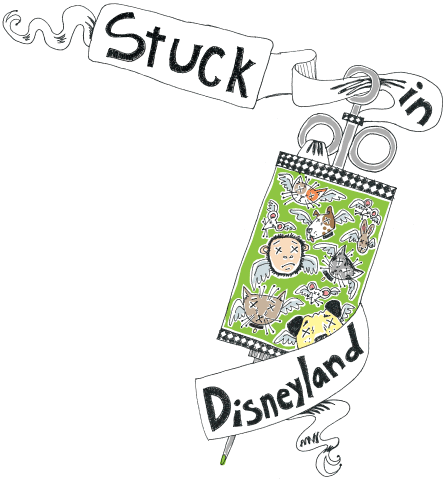
PETA’s underlying Disneyfied vision of nature is merely the laughable icing on the deeper cake of hypocrisy and extremism.
PETA’s underlying Disneyfied vision of nature – where everything coexists peacefully without suffering, pain, or death – is merely the laughable icing on the deeper cake of hypocrisy and extremism. The group funds the ALF – an organization that firebombs laboratories conducting experiments with animals – and decries any and all animal testing, while simultaneously benefiting from its results. Case in point: PETA’s Senior Vice President, MaryBeth Sweetland, is a type A diabetic kept alive with synthetic insulin. She apparently doesn’t see this as a moral quandary.
“I’m not going to take the chance of killing myself by not taking insulin,” she said. “I don’t see myself as a hypocrite. I need my life to fight for the rights of animals.”
What’s more, PETA’s definition of ethical treatment includes the euthanizing of nearly two-thirds of the unwanted domesticated animals that come into their care. From July 1998 through December 2005, the group killed over 14,400 dogs, cats, and other “companion animals.” In 2005, 31 felony counts of animal cruelty were brought against two PETA employees for the unlawful disposal of animal carcasses in North Carolina dumpsters. According to veterinarian Patrick Proctor, PETA told North Carolina shelters they would try to find the dogs and cats homes. He handed over two adoptable kittens and their mother, only to learn later that they had been swiftly euthanized.
Finally, there are the over-the-top ad campaigns. Some highlights include: The “Holocaust on Your Plate,” a campaign which juxtaposed images of factory farms with images of holocaust prisoners and expectedly enraged the Jewish community. The “Are Animals the New Slaves?” exhibit, which displayed images of noosed black men hanging from trees alongside photos of slaughtered cows and was suspended after outcry from the NAACP. And last but not least, there’s the infamous “I’d Rather Go Naked Than Wear Fur” campaign, which utilized nude models to demonize fur. Hey, sex sells.
Rather than making ridiculous demands such as “total animal liberation,” activists looking to better the Earth should turn their attention to building local, eco-friendly methods of food and clothing production – animals and all. Because if the mere act of one species feeding on or utilizing another in pursuit of its own survival is unethical, PETA better move to another planet.
I got the principal idea of your speech…but from defending animals and make some mistakes in the way to being more harmful than helpful there is a big difference…i´m not some PETA big supporter but i agree with a lot of their work, even if extreme sometimes, but the animal situation is extreme as well and think that can´t be understand by somebody that still finding common points between fishing for pleasure and fishing for survive (That means respecting the nature and taking what you really need) or keeps the comparisions between use fur for coldness, shelters or tools in places in the 5th corner of the stoneage world and using fur for 5000 dollars clothes took away from animals while alive…there is levels of responsability and respect to animals, and the half of the humankind or more can live without take to many animals to the slaughter house or at least not for all those fake cosmetic-fashion-diet reasons. Is not in the hands of the african kids starving in the deserts or in the hands of the families living in the garbage dumps in the 3rd world contries. No, is in the hands of those that have the choice do a little for the animals that in this human egoism world can do nothing to defend themselves. Then is not just about PETA, or about pets, not even just about meat, is about us and about respect and worthy life for those that depend on us. Is about balance between living beings.
Sorry for my english, i hope at least part of the message arrive.
As a teacher I’ve called on Hugs for Puppies, the Philadelphia chapter of PETA famous for some of their “radical” stances on animal liberation, to come into the classroom and educate students about kindness, reciprocity, and respect for animals.
Like PETA and ALF I think we all hold humans to different standards than predators like pelicans. Peter Singer helps us understand better the reasoning behind Animal Liberation propaganda.
I think your perspective is very human-centered. Bears, cougars, pelicans get to eat meat! Why cant I eat meat?
“Racists violate the principle of equality by giving greater weight to the interests of members of their own race, when there is a clash between their interests and the interests of those of another race. Similarly speciesists allow the interests of their own species to override the greater interests of members of other species.”
“For the great majority of human beings, especially in urban, industrialised societies, the most direct form of contact with members of other species is at meal-times; we eat them. In doing so we treat them purely as means to our ends. We regard their life and well-being as subordinate to our taste for a particular kind of dish. I say “taste” deliberately – this is purely a matter of pleasing our palate. There can be no defense of eating flesh in terms of satisfying nutritional needs, since it has been established beyond doubt that we could satisfy our need for protein and other essential nutrients far more efficiently with a diet that replaced animal flesh by high-protein vegetable products.”
Peter Singer
I am constantly amazed that this article is so misconstrued.
How is my viewpoint human-centered? It is the opposite of human-centered. PETA’s viewpoint is human-centered because they assume as human beings we are somehow separate from the ecological laws that hold predation and a species depending on another species for survival as essential.
Secondly, PETA practices speciism by assuming its better to kill a carrot for food than to kill a rabbit. Also by only giving a shit about cute mammals but not caring one bit about saving cockroaches (or apparently house cats). Hug a puppy? How about save a spider in a cup and let it go outside.
The only point of this article is to illustrate that the problem isn’t the ethics of eating meat. The problem is our declaring dominion over the web of life. Again, hunter-gather cultures hunt food, have respect for the animals they kill and a great connection to them, and have a smaller ecological footprint (and therefor less adverse effect on the entire web of life, including the ability of all animals to survive) than a suburban dwelling vegan.
Of course urban citizens only coming into contact with animals through eating them is a tragedy. This is addressed above:
I might add that I am a vegetarian and think the cause of animal rights is a noble one. I just think animal rights extremists are misguided and do the cause a disservice with their black and white worldview.
How is the act of a human eating meat in a sustainable and ethical fashion of detriment to any other species?
Yes, free the chickens. Let them be massacred by foxes rather than leading lives of content laying eggs on an organic farm and being eaten at the end of their lifespan.
Hmmn. I wasn’t aware that PETA was an environmental organization–I thought the point was animal rights first, use saving the environment as an incentive program.
If your problem with PETA is that an animal rights platform is not necessarily an ecologically sound one, you might be right. But I don’t know that it’s a particularly meaningful bone to pick.
Also, I think you are trying to frame your argument from the point-of-view of a species, whereas PETA tries to frame their argument from the point-of-view of the individual animal. When you say “How is the act of a human eating meat in a sustainable and ethical fashion of detriment to any other species?,” well, it might not be. If you change the question to “How is the act of a human eating meat in a sustainable and ethical fashion of detriment to any other CREATURE?,” the one who died for the meal might have a pretty smart answer. That’s if it could talk. And it weren’t dead.
And as for the chickens–if they weren’t domesticated, they would still be living in the jungles of Vietnam, where they are well-adapted to living with local predators. After all, isn’t that the way nature is supposed to work?
My problems with PETA, and PETA’s general viewpoint, are numerous.
1. PETA is hypocritical – they kill animals after telling people they will look for homes for them, and their members benefit from animal research.
2. PETA’s overly hostile approach gives rational animal rights proponents and vegetarians a bad name.
3. Their point of view disregards the operation of natural ecosystems.
4. Their viewpoint is emotionally driven and illogical – not to mention narrow-minded. This gives credence to the Ultra Right viewpoint that all environmentalists are bleeding-heart fools with absolutely no logical basis to their arguments.
And why exactly would anyone want to care about a particular CREATURE over an entire SPECIES. That’s just silly, to be nice about it.
Chickens are domesticated. That’s the fact. The question is what will happen when domesticated chickens are released – which is apparently what PETA would desire.
They will be eaten. Or they will die of old age. Either way they will die. Everything dies and death isn’t decidedly negative.
PETA sees the world through the eyes of a naive child and assumes if we pay make-believe long enough we can transform a world where life feeds on death and death feeds on life into a perfect utopia (that is, unless you’re a carrot).
Your essay has a few problems, but first I will say that there are things I dont like about Peta-such as all its naked campaigns, and I think its involvement in kill shelters is a bad thing(even though I understand the arguments behind it).
It also may compromise too much and just be too big of an organization. The Sierra Club, WWF and Nature Conservancy are much dirtier–they are all hunter friendly organizations(I will get to the problem with hunting in a minute).Big organizations often go corrupt. It could well happen to Peta, however, the good thing about it is that it has moved animal rights into the mainstream, and this is one reason why its attacked(the other being that it is the largest of those groups so the easy target). Prior to Peta, it was always a focus on animal welfare(i.e. its ok to whip your horse, just dont do it every day). Despite all the attacks and claims of terrorism, the celebrities still do ads for them-and while I dont think a reliance on celebrities are a good thing, Peta is smart and knows that it can spread influence. Peta also is a publicity seeker-which is why they are willing to offend(frankly, if its a choice between offending a human or highlighting some atrocity, fraid I gotta go with the latter, just on the principle of justice). Now, as for your article problems. The first is your title. You want to say Peta is lost in Disney land–and yet it is zoos and marine parks that have an unrealistic view of Nature. They make whales and seals do tricks for the public-when elephants go on a rampage because they dont like being beaten by a puny human–the circuses and zoos act as if it is a big shock–that elephants LOVE people, that it isnt possible elephants might hold a grudge, you know, act wild and unDisney-like. So–your title is a little unfair.
Then you cite violence in Nature to perhaps suggest that since Nature can be cruel, we shouldnt try to be compassionate. There’s a wee little problem there–and that is, humans are also cruel to each other, yet you wouldnt say(I presume) that we should let the normal and natural acts of human predation upon other humans go on. You might say-“but its the best interest of all humans to care about human rights.” Actually its not necessarily the case. A dictator doesnt need to think about human rights-some have died peacefully in their beds–clearly thieves don’t believe it, or rapists. Wars happen despite all the rhetoric about how precious human life is. So, the idea that we ought to only care about harm done to humans is biased and unfair, because that type of violence is just as natural as a spider catching a fly. You may not want to admit it, but thousands of years of human history cant easily be refuted.
Then, hunting. Problem there is, humans are not “natural” hunters and this is very easy to prove. Humans need tools to kill. Without them, they can only catch insects or weak birds. If you counter that the human brain is the weapon, and the tool making is just the means of equaling the fang and claws of a tiger–well, you have reality to contend with. The tool making ability of humans can be used for three purposes: to hunt non humans, to till the soil for agriculture, or to kill other humans. You dont have so many cases of lions and tigers attacking each other. I will qualify “natural” hunter by saying that if humans are natural hunters of other species, they are also natural hunters of their own kind(again proven by human history).
While I agree that hunting may be less violent or cruel than factory farms-this can be the same as saying being burned alive is better than being skinned alive. Just because it may be so, dont make it just. Humans do not need to eat meat. Its a fact(never mind what the UN says about global warming or the wasting of fresh water to feed livestock).
Fishing–I give special kudos to Peta for going after this-because the weaker and wimpier groups wouldnt dare.
Fishing is unnecessary(until humans can jump into the ocean and catch fish with their teeth).Seals are being slaughtered by the hundreds of thousands in Canada because humans killed all the fish in the north Atlantic region.The government tries to blame the seals(and yet they sell the seal penises to China to help with their impotency problem–sure was news to me!).
The “use all of the slaughtered animal” argument. Problem there is, the Nazis did that-it doesnt defend unnecessary exploitation.
Y And aboriginal groups dont get a pass in my book–most of them use western technology even when they claim they want to hold on to traditions. They arent advocating a return to the practicing of human slavery, or volcano sacrifices–its a double standard and unfair.
You also call Newkirk a hypocrite for the insulin. She should have used the argument that was given to Auschwitz camp survivors in 1989 when they wanted Mengele’s research destroyed. They were told it could be used to help humans. So chances are, if you are against research on unwilling human subjects-you are a hypocrite yourself. J Marrion Sims performed experiments on black slaves-he removed the jaw of one man without anesthetic, and he was named head of the American Medical Association and has a statue in Central park. Pfizer experiment on black children in Africa. “Even if Americans were willing to participate in trials, they take so many medications that they make poor lab rats anyway, clinical researchers say. To prove a new drug safe and effective, “you want patients with no other disease states and no other treatments. Then you can say relatively clearly that whatever happens to those patients is from the drug,” The Nation. Globalizing Clinical Research: Big Pharma Tries Out First World Drugs on Unsuspecting Third World Patients by Sonia Shaw.
You can read more on it here: http://animalvegfaq.tripod.com/ (it also debunks all the common anti-ar arguments).
Also, if you pay taxes or live on land thatw as taken in colonial war, and yet claim you are for human rights, you are something of a hypocrite yourself. The anti-animal rights people are the most hypocritical because they expect animal activists to be perfect, but not themselves.
My favorite is the Holocaust on the Plate complaint. The word “holocaust” is from the ancient hebrew and means “the sacrifice of a male animal on the altar of God.” So apparently, its ok to use the word to describe the victimization of humans, but when Peta uses it in reference to the actual original intended victim, that’s a no no. Tad bit unfair. Ditto for the black slave thing. James Boswell, who was a famous biographer, was a fierce proponent of the slave trade. His arguments sound very much like the ones used today by anti animal rights people: “To abolish a status which in all ages GOD has sanctioned, and man has continued, would not only be robbery to an innumerable class of our fellow-subjects; but it would be extreme cruelty to the African Savages, a portion of whom it saves from massacre, or intolerable bondage in their own country, and introduces into a much happier state of life; especially now when their passage to the West Indies and their treatment there is humanely regulated. To abolish that trade would be to shut the gates of mercy on mankind.”
The real problem is humans think they are superior to others(human and nonhuman) and come up with all sorts of arguments to defend it, but they dont stand up. They might even go absurd and say that if humans have to respect lions then lions have to respect them(ironically-Disneyfying Nature). Lions dont make claims they have rights–they just benefit from the fact that humans need laws to control their behavior(unlike other species). Who says morality needs to be reciprocal or a contract? Children, the mentally retarded and even criminals still benefit and they cant(or refuse to) reciprocate. Once again the unfairness. I could go on and on but these points are very tired and refuted at the link above in much more detail.
So all the points you raise in rebuttal fail for the same reason–chickens die, humans die. If its ok to kill one, its ok to kill the other(since both happen despite all the laws to curb it).
We should only care about the species, not the individual–there are arguments made suggesting we should do that with humans as well.
I think it is the anti-animal rights people who come across like naive children.They want to believe that humans have a special place in the universe–that they have a right to special protection and favor from a deity or the mindless universe, at the same time they want to victimize others.
In the Milgram experiment they found that a human was willing to torture(simulated) another human being just because an authority figure told them to. The same experiment was done with rats and rhesus monkeys except the subject would be shocked if they didnt cause harm to another member of their species–guess what? The rats and monkeys refused to do it. They were more altruistic than the humans! We could go on all day knocking this down but, Mark Twain said it best: “Man is the only animal that blushes, or needs to.” He also said humans are the only animal that will inflict pain on another knowing they are causing pain, and take pleasure from knowing that. Even the most violent domestic cat doesnt erect stadiums to let other cats watch them torture mice–but humans have done that with humans and nonhumans alike. The anti animal rights people need to grow up. Ciao.
@ Aweebler
1. I am not “anti-animal rights” and find most people who are against PETA as ridiculous as PETA and agree with you that they are naive. My purpose of this essay was to write an anti-PETA article from the point of view of a pro-animal rights vegetarian and environmentalist who is tired of animal-rights dogmatists giving the movement a bad name.
2. My comparisons to the natural world aren’t to insinuate that humans shouldn’t be compassionate. We have the option to choose to kill our food quickly as opposed to suffocating our prey to death or eating our prey while it is still alive. This, along with respecting your prey for giving its life for your survival, is compassionate. Perhaps in your view, we should be compassionate for all prey, but not for predators. Perhaps PETA could be more compassionate toward the humans on this planet that don’t have the luxury to drive to a Whole Foods and pick up some Tofurky.
2. Predation plays an important role in ecosystems, and human beings, as part of those ecosystems, became predators at some point during our evolution. In fact, before we really ever even were modern humans. To say that humans aren’t natural hunters is pretty ridiculous. Even chimps have made spears and have been documented hunting and killing monkeys. Just because we don’t have claws simply represents a different evolutionary path to the same thing: the ability to hunt prey. Species have developed a multitude of ways to hunt and kill or capture prey… some using cunning and some using brute force. One is not any more natural than the other.
3. An argument that hunting is OK is not the same as an argument that cannibalism or intra-species violence is OK. Most species avoid killing their own kind, and in struggles over territory generally fight violently but stop before fighting lethally. Even indigenous tribal warfare is not comparable to the institutionalized violence that has resulted from the establishment of civilization, and in fact, it has been argued by Daniel Quinn that tribal warfare actually served an important role in that it helped promote cultural diversity.
4. My argument isn’t that surviving off of other animals is OK because it is natural, my argument is that it is ecologically sound. I care about health of ecosystems before the health of an individual animal. After all, without healthy ecosystems all life is threatened. Agriculture has a history of having a MUCH more devastating effect on ecosystems than hunting or gathering.
5. Pointing out that theme parks Disnify nature is an accurate observation. However, it does not mean that my observation that PETA has a simplistic and anthropomorphic vision of the natural world is not equally valid.
6. I would rather test life-saving medical research on rats and monkeys before humans. If you disagree, feel free to volunteer to be experimented on. In the meantime, please avoid all life-saving medicine that has been developed as a result of animal testing. Perhaps PETA can have fun explaining to AIDs patients why we are no longer going to try and find a cure out of compassion for monkeys. Newkirk isn’t the one taking Insulin anyway, it’s MaryBeth Sweetland, and, yes, that makes her a hypocrite.
7. I personally agree with the Holocaust on your plate campaign. But, I also have the foresight to know that the only people who respond to something like that are people who already agree with it, and inevitably Jewish people will be offended. Duh. So, why in the hell would I launch ad campaigns guaranteed to make my cause look crazy? Oh yeah, because PETA is a media whore and just wants attention so they can get more donations.
8. Your entire reply is nothing but grasping at straw-men. You seem to think that by pointing out the dogmatic hypocrisy of an organization that in my opinion damages the cause of animal rights, I am thereby defending both our takeover of the natural world, and our tendency to be violent toward each other. So, I guess, you seemed to have missed the entire point of this article. (The problem is our viewpoint regarding our superiority over nature, not the simple act of using animal products).
My biggest problem with your comments, is you seem to think that anything we figure out how to do as a result of our large brains isn’t natural. You should read some Richard Dawkins books on how evolution works.
You claim to be pro animal rights and vegetarian, but your arguments suggest otherwise.
You sound like a human supremacist with some sort of religious adherence to science(I believe it is known as secular fundamentalism) and your arguments are based upon a subjective theory of life according to a human centered (and biased) view of ecology.
A subjective theory for human supremacy doesnt stand up to ethical scrutiny. You have to provide an absolute objective criteria of value-problem is, you cant. Any one that you present can be shown to be questionable(if it is questionable it cannot be absolute). If it is non absolute it leaves an opening for humans who dont care about human rights to argue that they have the justification to discriminate as they see fit(if you check the news, you will see that humans prey on each other all the time).
.
Case in point–you say that humans preying on other species is natural. I dont disagree–but you ignore that humans preying on other humans is also natural by the same standard of observation. Chimps also engage in warfare-and unlike humans, can rip a carcass apart without tools. Humans cannot. Lions and tigers can. By that standard, lions and tigers are more natural predators than humans.
You say “An argument that hunting is OK is not the same as an argument that cannibalism or intra-species violence is OK. Most species avoid killing their own kind, and in struggles over territory generally fight violently but stop before fighting lethally.”
**but humans do it. That’s your problem. It doesnt matter what other species do. Its what humans do. History. Humans do it all the time. They exploit each other in various ways. You want to have your cake and eat it too, that’s the trouble. More humans were killed by other humans in the 20th century than all other centuries combined. Seems rather natural. Did a deity or universal mechanism step in to stop human predation? I dont see it. Nature doesnt care. And some humans dont care. That’s your problem. You want some predation by humans but not another. Yet your belief system cant prove human supremacy, and it must to justify the discrimination from an ethical pov.
Saying that preying off other animals is ecologically sound doesnt really present much of an argument. Pushing humans into volcanos as Hawaiians did was ecologically sound-doesnt mean its necessary or ethically defensible. Ditto for human meat eating.
Arguing that agriculture is more destructive than hunting and gathering is debatable. Cannibalism is less destructive than agriculture as well. The ethics is where your argument hits a wall.
“I care about health of ecosystems before the health of an individual animal.”
**Irrelevant. Your view doesnt equal a solid ethical argument. Some people care about the health of ecosystems before the health of individual human animals. And some humans have done very bad things-like cutting down rain forests to raise soya to feed livestock in Europe. By your type of reasoning, killing them would be ok(again, your argument doesnt explain human supremacy–you just take it as a given..because if examined in detail, it falls apart).
.
Your comments on animal research show your adherence to the human supremacy myth. I see you didnt bother to go to:
http://animalvegfaq.tripod.com/animalresearchFAQ.html
Your pov is debunked quite well. So to save time I will repost it(the reason for the FAQ is to save activists time in argument since the arguments of anti ar people are so predictable). It debunks the argument completely and provides some bonuses.
One final note-Richard Dawkins is a secular fundamentalist-he can preach all he wants to about knowing how universe works. I dont adhere to his subjective non absolute theories, but I can see he has developed quote a cult following.
(ciao again-but if you insist on being debunked once again I will return to do as you request if you email me back)
1)It is a perversion of altruism and compassion–you attempt to heal Peter by torturing and killing Paul. It is like trying to help a homeless man by kicking a family out of their house, beating them to death and moving the former in (except that finding a home for the homeless man is a sure thing–animal researchers have been trying to cure cancer for hundreds of years without success). The fact that the number one answer to criticism of animal research is a citation of alleged benefits proves that animal researchers lack a common sense understanding of morality and ethics–since we wouldn’t allow murderers or thieves to cite the benefits they or their family attain from their actions to justify murder or theft.
2)It is a medical fraud–if you wouldn’t think it is rational to find a cure for diseases in giraffes by experimenting on elephants why would you think it is rational to cure disease in humans by using mice, rats, dogs or chimps? Animal research is big business (from cage manufacturers to science grant applicants), and scientists have a vested interest in conjuring up new experiments to keep their paychecks, while telling the public that the research is important and a “breakthrough.” (If you think animal researchers are strictly motivated by compassion, how many new drugs they develop can you get for free?) Pagan priests sacrificed animals and read their entrails to encourage the hope and health of society (a good harvest, easy childbirth). Those that opposed it endangered society by angering the gods. Today, animal researchers claim that if nonhuman animal research stopped, the world would descend into a hell of disease and misery (without explaining why society and culture endured even during the Medieval plague. By their logic, humans should have been extinct eons ago, plus it grossly exaggerates the power of medicine since humans continue to die from disease–including every scientist who has, does or will support animal research). Animal researchers promote the view that life works according to a quasi-Darwinian “Great Chain of Being” hierarchy where animals follow a ladder of complexity–starting with worms and ending with humanity, and that you can take them apart and reassemble them as easily as a jigsaw puzzle. If animal research is necessary for producing safe drugs and treatments why then do we need clinical trials on humans? Why does Pfizer have to conduct medical trials in Africa? Why do drugs like Thalidomide get pulled after being shown to be safe in nonhuman animals? If one had a choice between a drug tested only on rats or chimps, and a drug tested only on humans, which would you deem safer for people? The answer determines one’s belief in the importance on nonhuman animals in research.
3)Animal research treats nonhuman animals in ways that would be considered an atrocity if done to even the most despised criminal in history–and yet, nonhuman animals commit no crimes. Why do they deserve such treatment?
4)If finding a cure for disease is so important, why aren’t scientists and patients advocating the use of criminals or volunteers in medical experiments? Humans are the best and safest model for research, and we send healthy people off to be maimed and killed in wars for natural resources, religion and political ideology, and yet the war against cancer is only considered of dire importance when it comes to the discussion of abolishing nonhuman animals in research.
5)Researchers say animal research is necessary–and yet they eat meat, and engage in all other activities that are clearly not necessary. It shows that the necessity argument isnt even a real factor–they simply regard non humans as less in value and can do as they please with them.
6) Researchers say they need to use nonhuman animals for research because they are like us–and yet they say they deserve no rights because they are not like us. This highlights the real issue–the motivation for animal research beyond money is an arrogant belief that humans as a species are superior in value to all other life, based upon arbitrary, non-absolute and subjective criteria conveniently determined by those who stand to benefit from the discrimination and exploitation. The same reasoning was used by Nazi doctors to justify their experiments–a belief in the superiority of a group defined by those who stand to benefit from it. Ultimately, scientists engage in animal research because they, like researchers who were racial or Christian supremacists (J Marion Sims, Josef Mengele) believe their victims are inferior in value.
7) Animal researchers are not experts at preventing misery and death, but they are experts at causing them.
1) The myth that humans are superior in value as a group to all other lifeforms is not supported by a casual examination of natural phenomenon. The universe can not be shown to favor human beings–for volcanoes do not spew lava in ways that avoid humans, sharks do not get paralyzed if they attempt to bite human swimmers, and the laws of gravity have the same effect on them as any other lifeform. Whether you believe in a god or a mindless universe, human supremacy as an absolute objective truth cannot be demonstrated any easier than one could demonstrate that apples are superior to oranges, that one race is superior to another, or that the letter A is superior to the letter B. Such judgments can only be decided by humans–conveniently, the ones claiming their heightened status.
2)If you believe that humans can discriminate against and exploit other life because they are superior in value as a species to all others you have to be able to show this supremacy to be true as an absolute, objective fact. WHY? Because if you can’t, then anyone can use similar non absolute, subjective criteria from religion to gender to skin colour to justify discriminating against anyone else (human or not), which is what humans do every day all over the world regardless of the laws or moral standards in place.
Any standards of value used–“the faculty of reason,” “free will,” “a soul,” “my deity says so,” etc. are subject to doubt, not only in how each applies to all humans vs all non humans, but also in their absolute objective significance. Some humans are more intelligent or creative or faster or taller than some others–does that mean that the more intelligent or creative or taller ones deserve more rights than those who are less intelligent or creative or tall? If not, why? The standard can be doubted, just as it can be for the arguments of racial supremacists. For the sake of argument, however, if every human did possess a faculty x that other species lack, why then would this “faculty x ” make them superior in value–and then free to do what they want to those who do not possess it?
It is a purely human value and claim. Some human says it is so, so it is so.
3)The standard of “Reason” is subjective. It is a value judgement that only has discernable value to humans (just as skin color only has importance to racists, or a certain interpretation of the Bible only has worth to religious extremists). The universe itself cannot be shown to “favor” humans over non-humans since our kind is just as mortal as any other species. Erupting volcanoes do not alter their lava flows to spare humans; hailstorms do not drop their rocks of ice on everything but humans; and sharks do not get paralyzed jaws if they attempt to bite a human swimmer (in violation of some law of Physics that recognizes human supremacy). If a basic observation of Nature does not show how humans are superior (according to absolute and objective criteria) and deserving of special treatment, then what does?
4) If one says that humans are superior as a species according to the will of a Supreme Deity, how do you prove it? If you cite a Divinely-inspired religious book written down by individuals who conveniently, are members of the very group that stands to benefit from the discrimination, then anyone else can emphasize race, or gender, or wealth instead of (or in addition to) species and claim that the same deity (or another one) decided that theirs is the ultimate measure of value for determining superiority. Such disagreements cannot be objectively resolved—and they must be to avoid hypocrisy and moral corruption. To be a universal/absolute/objective truth it has to be the final answer to the question; it has to be beyond doubt (for how can the absolute be questioned?). Where then is this objective superiority of human beings demonstrated? Nowhere. Some human says it is so, so it is so.
How then can the human supremacist argue, using ethics, that what he says is so, is superior to what the racist says is so?
The only choices that he/she has to preserve moral integrity is to agree that anyone should be able to discriminate against whomever they want (i.e. this would allow both human and non human exploitation), or to extend the circle of compassion and ethical justice to include non-human living beings. This would preserve the principle of trying to be as compassionate and as fair as possible to others. At the most fundamental level it isn’t about love, or emotion, but ethical consistency and common sense.
5) An additional irony to the human supremacist myth is that when humans try to use certain criteria to show their superiority to other species, the opposite is often easier to prove. Example: humans likes to say they are more compassionate than other species, the words “humane” and “inhumane” show this–as humans like to think to be good is to be human, and to be evil is to be inhuman. And yet, altruism has been demonstrated in both domesticated and wild animals, across inter-species relations, even between traditional predators and prey. While these may be anomalies, the fact remains that at the same time altruism exists, we do not find examples of extreme cruelty and sadistic pleasure in the suffering of others among other species that humans have demonstrated throughout the ages. Humans have tortured and killed both humans and non humans in the name of religion, science, greed, sexual pleasure, entertainment etc. They have victimized others and enjoyed causing suffering, especially when they know that their victims are suffering. No other species has been shown to do this. Cats do not erect stadiums where other cats can watch mice being tortured, as humans did with the Roman Coliseum, and with bullrings or cock pits. Humans also like to say they were meant to be stewards of Nature, but it is humans who have caused deforestation, water and air pollution, extinction, soil erosion. And yet, the creatures that humans consider to be the lowest in significance and worthy of insult, insects, are responsible for maintaining the flora that all life including humans depend on. So by just these two criteria put forth by humans, other species are shown to be superior to them. This is another reason why humans should show some humility. And for those who believe in Biblical story, Pride was considered the greatest sin.
**final note–I really wish antis would try to come up with new arguments. Their arguments are dull.
I am a bit confused how thoroughly you’ve managed to misunderstand my position.
I am the first person to argue that humans do NOT have superior value to the rest of the natural world. Much of my viewpoint is decidedly Quinnian, and debunking the idea that humanity is the end-all result of creation is its central tenant. My entire article was an attempt to point out that this human-centric belief is what is causing problems in our relationship to the animal world… not simply subsiding off of other species, and my factual backup is the fact that ALL species subside off of other species. In fact, it is this very relationship that gives rise to the biodiversity that exists on this planet. Competition for mates, food and survival fuels evolution.
When threatened, any animal will use any means at its disposal to survive. We have no obligation to avoid medical research simply out of sympathy for other animals. But that doesn’t mean we should abuse animals sadistically either, and there are in fact laws that seek to prevent this (I believe I even gave PETA credit for this in the article).
The bottom line is, while I don’t believe humans are intrinsically more important than other species, I am still human. Therefore, I’d find it rather difficult to tell a member of my own species we aren’t going to provide them with medical care because we can’t do tests on animals. You mention the tired line about not doing experiments on one species to learn about another. Well, that’s pretty well disputed by the actual scientists doing the research, not to mention the results of their research. In fact, I think they’d find your statement laughable considering everything that animal research has accomplished. This is precisely the type of statement that drives me away from the animal rights movement, because it is simply not backed up by fact, but repeated like a mantra nonetheless.
In regards to our treatment of each other, I think our difference here is I don’t see our treatment of each other prior to the development of agriculture and civilization to be much different than the territorial disputes of other species. Versus most of the sadistic behavior you mention which is primarily the result of a class-based civilization and overpopulation. You say things like “ages” and for all of “history” forgetting that there was an entire block of time much longer than “history” known as prehistory when we weren’t erecting stadiums to entertain us with barbarity.
You accuse me of “discriminating” against animals, and yet you seem to have no problem in discriminating against the rest of the natural world so we don’t have to eat fish or mammals.
You are in fact subscribing a greater value to animal life than plant life, or even insects for that matter. Where do you draw the line? What are we not allowed to eat? I subscribe equal value to all life on this planet and realize that the very nature of life itself is that life feeds off of other life. If this is wrong, then all of life is unethical.
What humanity needs to realize is that life doesn’t exist explicitly for us, and that when we place ourselves above the rest of the natural world we only do ourselves ill as we are destroying our own means of livelihood in the process.
In fact, I would argue, by assuming that humanity is somehow required to function differently than every other species on the planet and forgo very basic aspects of an ecological system out of some higher sense of morality, one merely serves to exacerbate our separation with the web of life.
I realize there could be some back and forth here in relation to ethics (probably something neither of us has time for), but leaving the research issues aside, trying to make a case against hunting is simply ludicrous.
Predation is ESSENTIAL in most ecosystems to keep them healthy, and subsiding off of hunting has an extremely small ecological footprint compared to subsiding off of agriculture.
I want you to read Dawkins, not for his opinions, but because he is really good at explaining the science behind evolution… at the very least it’s interesting reading and I’d especially encourage you to check out “The Selfish Gene” and “The Greatest Show on Earth”. I’d also encourage you to read “Ishmael” and “The Story of B” by Daniel Quinn.
I have argued this subject for about 20 years. I have had some communication with a variety of points of view-professors, hunters, pig farmers, Tim Wise(racism activism), vivisectionists, even Michael Pollan who wrote a rather poorly researched article on the history of animal rights philosophy for the NYT. In fact, I found your site because I was looking for a market for an essay on the subject-and came across your article by accident.
I used to debate this topic quite a lot-but over time got tired of it because the debates dont really change. You can poke many holes in the anti animal rights argument-but usually a denial kicks in and they avoid the central points.
I think the animal rights movement needs to update their debate philosophy for the 21st century. Singer was a start but his argument has flaws. Francione is an improvement but he also leaves a few gaps.
I already listed the argument above and wont repeat it. You say you dont believe humans are superior in value as a group according to a subjective non absolute criteria of value conveniently determined by those who stand to benefit from it, but your argument is entirely based upon it.
You say you value the species not the individual and yet your double standard is glaring. When it comes to medical research, you ignore that disease is natural-all species are affected by it. Individuals die. Death is natural-and yet humans are the only ones that seek to prolong life artificially for the few individuals. You ignore the fact the humans are the best models for humans and that humans will send other humans to be maimed and killed for war-so why not use them as volunteers for medical research? Clearly the fight for cancer isnt as important as fighting for ideology or oil reserves. No matter how you slice it-you can take the nonhuman out of animal research, but you cant remove the human. There isnt a treatment on the market that didnt need humans. That is why Pfizer is in Africa. That’s why Mengele’s research was saved and used.
You basically just dont want to admit that human predation upon other humans is entirely natural-it is happening as I type this, in many forms. But you want to say that is not natural(when it clearly is) and the reason is because you get soft. You want to say life is cruel and all that-but you set up an artificial barrier–at the species line–and yet, not all humans agree with you. That’s human nature..
So–you can try to claim that your view is fair and just–and ethically constructed–but its still based upon the human supremacy myth detailed above. You just seem to adhere to what might be called specific revelatory secularism. It doesnt change the ethics. Humans prey on other humans. It is natural. Yet you want to say it is wrong. But it is no less natural than humans preying on other species. Humans have no barriers. We kill each other-we are uncontrolled sexually(having sex with corpses etc). If humans want to have a standard of ethics and moral view that prevents racists and other human predators from having a moral argument to prey on each other, one needs to adopt a view that has humans trying to curb discrimination and exploitation as much as possible. That extends to their relationship with other species.Its a simple matter of consistency and fairness. Where one draws the line was already discussed above. I would read the books you mention, but they arent really about the ethics. The beauty of ethics is that you dont need a textbook. Its all common sense and observation. I would suggest you read about the three main branches of religious thought–secularism, theism and mysticism. It might help you to understand how subjectivity and absolutes play into this type of ethical discussion.
My response is that medical research is about the species and not necessarily the individual. I am focused on the overall idea of medical progress. Particularly a contagious disease such as AIDS is a species issue as well as an individual issue. Also, to reiterate, any animal would defend its life were it threatened through any means at their disposal. We are animals. When disease threatens us (as it naturally does) we have the right to defend ourselves to the best of our ability (within the laws of limited competition). The list of things that have been discovered as a result of animal research is simply overwhelming. And the three “R”s of medical research are supposed to help ensure that we only test things on animals when we have to, and we do not cause them undo suffering. I am not naive enough to assume that this is what happens in every circumstance, but the antics of groups like ALF/PETA do more harm than good.
And I agree with you that human subjects are in many cases preferable, and much of the time they are used. However, the model of animal research is that animals are used to develop a model to then test on humans. In most cases, if such a model hasn’t been developed the procedure would be too risky to conduct on humans. Now, if you want to step forward and volunteer, go for it. I’m not going to, and neither will most others. So now we are right back where we started. When every member of ALF volunteers to be subjects of medical research, completely disavow the use of all medical treatments developed from animal testing, AND they can look into the eyes of a room full of AIDS patients and tell them why they view the lives of lab rats to be of greater value than theirs, I will start to take them seriously. The likes of ALF are choosing to place a superior value on the lives of lab animals over the lives of humans. So they disagree with someone trying to say an orange is superior to an apple, but in the process they functionally argue the opposite, which is equally as false. Just as they are functionally arguing that rabbits are superior carrots, and therefor eating a carrot is ethically sound but eating a rabbit isn’t.
We have to eat, as does everything. I don’t think that eating a rabbit is any more unethical than eating a carrot… so long as you don’t torture the rabbit first or make it spend its life wallowing in its own shit.
I am not trying to say that “natural” is synonymous with good in an ethical sense. Technically it’s a meaningless term as everything is natural since it exists. But I don’t see grounds for an ethical argument against subsistence hunting, unless the argument is that all killing is wrong, in which case stop eating everything that’s not a fruit, etc.
Lastly, I just simply do not feel I am making an “anti animal rights” argument. I am making an anti “we should never use animals for our own benefit, regardless of how well we treat them and firebomb the facilities of those who disagree” argument. And, I am making an argument against the tactics employed by PETA as being detrimental to the cause they are trying to promote. I stand by both these points.
My motivation for writing the article was that it is difficult, if not impossible, for me to turn people on to vegetarianism, or to even assert it as my own lifestyle choice, without people jumping to conclusions that I support PETA and the tactics of groups like ALF. If animal rights extremists didn’t exist, I’d have a much easier time promoting an ethical diet. I’d like to focus on getting rid of factory farming by promoting CSA’s and enacting solid and enforced animal cruelty laws, and when that’s done, if animal rights extremists want to convert the world to veganism they can have their shot… in the mean time they are getting in the way.
Oh, you’re right, the books I mentioned aren’t primarily about ethics. They are about ecology, which is just as important to the conversation. Besides, even if you forgo the Dawkins it sounds like you’d like Daniel Quinn.
Yeah unfortunately you still have the inconsistency problem. You say you care about the species-but medical research helps the individual-the species is fine. The bubonic plague didnt wipe humans out. Medical research is not necessary for species survival.
And alf members dont need to volunteer. Its the humans who claim that medical research justifies creating victims that need to volunteer(i.e. you).
The reason you cant convince people to be vegetarian is because your arguments are anti-animal rights. It just doesnt work in your case. Its better to let animal rights activists do the debating.
Yup, disease epidemics have never wiped out or seriously set back a species before. No sir. And it sure is possible to scientifically test medical procedures without test subjects. Because, you know, the whole point of science being to develop a tested and repeatable methodology. Scientists must just torture animals for fun and reject all alternatives to medical research because they are sadists — not because alternatives don’t exist (if they do, scientists are legally obligated to pursue them). Sure hope you never need heart bypass surgery or a blood transfusion… I’ll be sure to let the doctors know you are sacrificing yourself for your cause.
I am not following the “consistency” issue anyway. Just because I said I care more about the survivability of a species than an individual animal, doesn’t mean I don’t care at all about the individual animal, just that when it comes to ethical considerations something that threatened a species would take priority. In the case of medical research I am advocating a point of view that helps our species as a whole, and helps individuals. It may not help individual lab rats, but medical research is certainly not a threat to the rat population in general. More animals get hit by cars every day than get tested on. Why not start fire bombing car dealerships in the name of animal rights?
The reason I can’t convince people to consider vegetarianism is because they assume that I am trying to convince them that eating meat is ethically wrong, something almost all of humanity completely disagrees with (including me), versus trying to convince them that the way we go about eating meat is ethically wrong, or that vegetarianism has a smaller environmental impact — a much easier task.
Caring about animals means caring about ourselves too. The main reason I became an environmentalist is out of self-interest and the interest of self-preservation when it comes to my own species. I understand that we are interconnected with the natural world, and by fucking it up we are fucking up ourselves. Eating meat in a sustainable manor does not damage our own chances of survival and its impact on the environment is negligible (in fact predation helps ecosystems stay healthy, thereby benefiting other species… even the prey species). If I bothered myself to feel bad about things dying so other things can take a turn at life I wouldn’t be able to get out of bed in the morning.
You accuse me of having a human-centric viewpoint and I have thought a lot about this and come to the conclusion, that to an extent you are right. You’d be wrong if you said I subscribed some sort of divine value to humanity in the greater scheme of things, or felt that humanity has a greater right to life than other species. But we, nonetheless DO have a right to life, and we have a right to try and make that life as rewarding as we can. As a human being I personally have a greater sympathy for the suffering of humans than the suffering of animals because I connect more closely with my own species. What animal rights activists are asking is the equivalent of asking someone to care for a perfect stranger before their own family member. Some people will kill other members of their own species simply to protect a family member from harm, despite not condoning murder otherwise. Similarly, I don’t condone experimenting on animals for no good reason (cosmetics), but if it will save a member of my own human family I’d be hard pressed not to condone it if there are no other options (and there are none).
I think having a little more sympathy for our fellow human animals would do PETA and ALF some good.